When choosing a numerology system, understanding the origins, methods, and foundations of each approach matters. While both systems assign numerical values to letters and seek to reveal personal insights, their histories and philosophical underpinnings couldn’t be more different.
This comprehensive comparison will help you understand the key differences between modern “Pythagorean” numerology and authentic Kabbalistic numerology—so you can choose the path that resonates with your search for truth.
Executive Summary ⚡
Don’t have time to read 5,000 words? Here’s what you need to know:
Modern “Pythagorean” numerology:
- Has no historical connection to Pythagoras ✗
- Uses incorrect letter values (I≠Y, U≠V≠W) ✗
- Doesn’t match actual Greek numerology ✗
- Was invented in the 1800s-1900s ✗
Kabbalistic numerology:
- 2,000+ years of documented history ✓
- Correct phonetic calculations ✓
- Rooted in Hebrew Gematria ✓
- Matches authentic ancient Greek system structure ✓
Bottom line: One system is historically false with wrong math. The other is authentic ancient wisdom with correct calculations.
Continue reading for complete evidence and examples →
Pythagorean vs Kabbalistic Numerology Quick Comparison Table
| Aspect | “Pythagorean” Numerology | Kabbalistic Numerology |
| Historical Origin | Modern creation (19th-20th century) | Ancient Hebrew mysticism (2,000+ years) |
| Connection to Namesake | No documented link to Pythagoras | Direct lineage to Kabbalah tradition |
| Source Texts | None from antiquity | Sefer Yetzirah, Zohar, Talmudic writings |
| Number System | 1-9 (consecutive: A=1, B=2, C=3…) | Hebrew letter values (varied: Aleph=1, Beth=2, Yod=10…) |
| Alphabet Used | Latin/English alphabet | Hebrew alphabet (22 sacred letters) |
| Philosophical Foundation | Modern New Age interpretation | Jewish mystical tradition, Gematria |
| Master Numbers | 11, 22, 33 (modern addition) | 11, 22 (based on sacred combinations) |
| Cultural Continuity | Disconnected from source | Living tradition practiced for millennia |
| Spiritual Depth | Personality-focused | Soul-purpose oriented |
The Historical Truth: Origins and Authenticity
“Pythagorean” Numerology: A Modern Attribution
The Reality: Despite its name, modern “Pythagorean numerology” has no demonstrable connection to the ancient Greek philosopher Pythagoras (c. 570-495 BCE).
What we know about Pythagoras:
- He studied mathematics, music theory, and cosmic harmony
- He founded a philosophical school that explored number symbolism
- He taught that numbers represented universal principles
- However: No historical documents, manuscripts, or credible ancient sources show he created personality analysis systems based on names or birthdates
When it actually emerged: The system commonly called “Pythagorean numerology” appeared in the late 19th and early 20th centuries, primarily through:
- Western occult revival movements
- New Thought philosophy
- Popular books on mysticism and self-help
- Authors who retroactively attributed their systems to Pythagoras for credibility
The name “Pythagorean” was borrowed to lend ancient authority to what was essentially a modern invention. While Pythagoras certainly revered numbers, linking his name to contemporary numerology charts is historically unsupported.
This doesn’t mean the system has no value—many people find insight through it. But it does mean you’re working with a recent interpretation, not an ancient wisdom tradition.
Kabbalistic Numerology: Ancient and Documented
The Reality: Kabbalistic numerology emerges directly from Gematria, the ancient Jewish practice of assigning numerical values to Hebrew letters—a tradition with over 2,000 years of documented history.
Historical Evidence:
- Sefer Yetzirah (Book of Formation): Dating to roughly 200-600 CE, this foundational Kabbalistic text explores the mystical properties of Hebrew letters and their numerical values
- Talmudic writings: References to Gematria appear in rabbinic literature from the 1st-5th centuries
- The Zohar: This 13th-century masterwork of Jewish mysticism extensively uses numerical letter values for scriptural interpretation
- Continuous tradition: Jewish scholars, mystics, and Kabbalists have studied, practiced, and transmitted this system without interruption for millennia
The Hebrew Alphabet Foundation: Hebrew letters aren’t just symbols—each carries:
- A numerical value (Aleph = 1, Beth = 2, Yod = 10, etc.)
- Spiritual meaning and energy
- Connection to creation narratives in Torah
- Mystical significance in Kabbalistic cosmology
When you practice Kabbalistic numerology, you’re engaging with a living tradition rooted in ancient scripture and passed through generations of devoted study.
Calculation Methods: How They Differ
“Pythagorean” Method
Uses a simple 1-9 consecutive system applied to the English/Latin alphabet:
A=1 B=2 C=3 D=4 E=5 F=6 G=7 H=8 I=9
J=1 K=2 L=3 M=4 N=5 O=6 P=7 Q=8 R=9
S=1 T=2 U=3 V=4 W=5 X=6 Y=7 Z=8
Process:
- Assign each letter its number
- Add all numbers together
- Reduce to a single digit (unless 11, 22, or 33)
Example: “JOHN”
- J=1, O=6, H=8, N=5
- 1+6+8+5 = 20
- 2+0 = 2 (Expression Number 2)
Kabbalistic Method
Uses the Hebrew alphabet with its traditional numerical values, adapted to English letters through phonetic correspondence:
The system reflects how Hebrew letters map to sounds, creating a more complex but spiritually aligned calculation.
A=1 B=2 C=3 D=4 E=5 F=8 (for PH sound)
G=3 H=5 I=10 J=10 K=20 L=30
M=40 N=50 O=70 P=80 Q=100 R=200
S=300 T=400 U=6 V=6 W=6 X=60
Y=10 Z=7
Key differences:
- Values escalate (reflecting Hebrew letter structure: units, tens, hundreds)
- Some letters share values based on phonetic similarity
- Master Numbers (11, 22) emerge naturally from sacred letter combinations
- The method honors the original Hebrew mystical framework
Example: “JOHN”
- J=10, O=70, H=5, N=50
- 10+70+5+50 = 135
- 1+3+5 = 9 (Expression Number 9)
Why this matters: The same name can yield different numbers in each system, leading to different interpretations. The question becomes: which system’s foundation do you trust more?
The Greek Numerology Evidence: Proof “Pythagorean” Isn’t Even Greek
Here’s where the deception becomes undeniable.
If “Pythagorean” numerology were genuinely connected to Greek philosophy or Greek mathematical traditions, it would use Greek gematria—the ancient Greek system of letter-number correspondence that actually existed in Pythagoras’s time.
But it doesn’t.
Actual Greek Letter Values (Isopsephy)
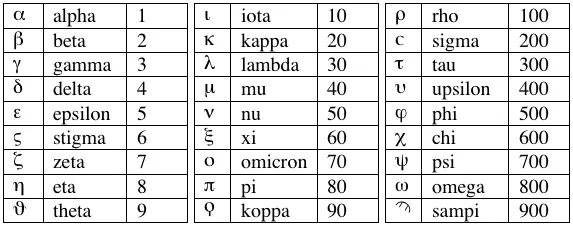
Greek Numbers Table: values are closer to Kabbalistic Numerology / gematria than pythagorean numerology.
Ancient Greeks used their alphabet for numerical values in a system called Isopsephy (similar to Hebrew Gematria). Notice the pattern:
- Alpha (A) = 1
- Beta (B) = 2
- Iota (I) = 10
- Kappa (K) = 20
- Rho (R) = 100
- Sigma (S) = 200
Sound familiar? This escalating pattern (units, tens, hundreds) is exactly what Kabbalistic numerology uses—because both systems derive from ancient Semitic numerical traditions that influenced the Mediterranean world.
Hebrew Gematria for Comparison
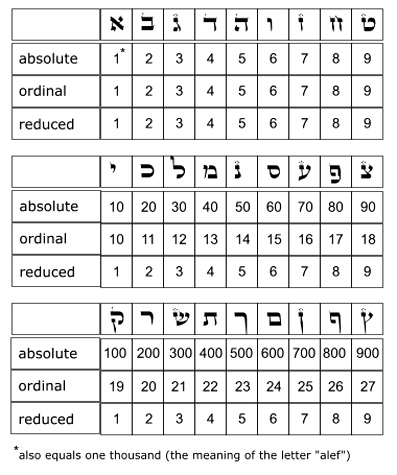
The Hebrew system follows the same principle:
- Aleph (A) = 1
- Beth (B) = 2
- Yod (I/Y) = 10
- Kaf (K) = 20
- Resh (R) = 200
- Shin (S) = 300
The structural similarity is not coincidence—it reflects how ancient cultures understood the sacred relationship between letters, sounds, and numbers.
Modern “Pythagorean” System
Now compare this to what’s marketed as “Pythagorean”:
- A = 1, B = 2, C = 3, D = 4…
- Simple consecutive numbering 1-9, repeating
- No connection to Greek isopsephy
- No connection to Hebrew gematria
- No connection to ANY ancient system
The verdict:
If this system were truly Greek or connected to Pythagoras, it would resemble Greek isopsephy.
It doesn’t.
If it were ancient at all, it would show similarities to documented ancient systems.
It doesn’t.
Instead, it’s a simplified, modern invention that bears no resemblance to the numerical traditions of any ancient culture—Greek, Hebrew, or otherwise.
“Pythagorean” numerology isn’t just incorrectly named. It’s completely fabricated, with no roots in Greek, Hebrew, or any authentic ancient tradition.
Meanwhile, Kabbalistic numerology maintains the authentic structure that both Greek isopsephy and Hebrew gematria share—because it comes from the real ancient source.
Greek Gematria Adapted to English Alphabet
What “Pythagorean” Numerology Should Actually Look Like
If “Pythagorean” numerology were genuinely based on ancient Greek tradition, it would adapt Greek Isopsephy (Greek gematria) to the English alphabet by matching letters phonetically.
Ancient Greek Isopsephy – Original System
| Greek Letter | Name | Sound | Value |
|---|---|---|---|
| Α α | Alpha | A | 1 |
| Β β | Beta | B | 2 |
| Γ γ | Gamma | G | 3 |
| Δ δ | Delta | D | 4 |
| Ε ε | Epsilon | E (short) | 5 |
| Ϝ ϝ | Digamma | W/V | 6 |
| Ζ ζ | Zeta | Z | 7 |
| Η η | Eta | E (long) | 8 |
| Θ θ | Theta | TH | 9 |
| Ι ι | Iota | I | 10 |
| Κ κ | Kappa | K | 20 |
| Λ λ | Lambda | L | 30 |
| Μ μ | Mu | M | 40 |
| Ν ν | Nu | N | 50 |
| Ξ ξ | Xi | X | 60 |
| Ο ο | Omicron | O (short) | 70 |
| Π π | Pi | P | 80 |
| Ϙ ϙ | Qoppa | Q | 90 |
| Ρ ρ | Rho | R | 100 |
| Σ σ | Sigma | S | 200 |
| Τ τ | Tau | T | 300 |
| Υ υ | Upsilon | U/Y | 400 |
| Φ φ | Phi | PH/F | 500 |
| Χ χ | Chi | CH/KH | 600 |
| Ψ ψ | Psi | PS | 700 |
| Ω ω | Omega | O (long) | 800 |
| Ϡ ϡ | Sampi | (archaic) | 900 |
Authentic Greek-Based English Adaptation
Phonetic Matching Principle:
English letters are matched to Greek letters based on their sound, not alphabetical order. This is how any legitimate ancient-to-modern adaptation should work.
| English Letter | Greek Equivalent | Sound Match | Authentic Value |
|---|---|---|---|
| A | Alpha (Α) | /a/ | 1 |
| B | Beta (Β) | /b/ | 2 |
| C | Gamma (Γ) or Kappa (Κ) | /k/ or /s/ | 3 or 20 * |
| D | Delta (Δ) | /d/ | 4 |
| E | Epsilon (Ε) | /e/ | 5 |
| F | Digamma (Ϝ) or Phi (Φ) | /f/ | 6 or 500 * |
| G | Gamma (Γ) | /g/ | 3 |
| H | Eta (Η) | /h/ aspirate | 8 |
| I | Iota (Ι) | /i/ | 10 |
| J | Iota (Ι) | /j/ (y sound) | 10 |
| K | Kappa (Κ) | /k/ | 20 |
| L | Lambda (Λ) | /l/ | 30 |
| M | Mu (Μ) | /m/ | 40 |
| N | Nu (Ν) | /n/ | 50 |
| O | Omicron (Ο) | /o/ | 70 |
| P | Pi (Π) | /p/ | 80 |
| Q | Qoppa (Ϙ) | /kw/ | 90 |
| R | Rho (Ρ) | /r/ | 100 |
| S | Sigma (Σ) | /s/ | 200 |
| T | Tau (Τ) | /t/ | 300 |
| U | Upsilon (Υ) | /u/ | 400 |
| V | Digamma (Ϝ) or Upsilon (Υ) | /v/ | 6 or 400 * |
| W | Digamma (Ϝ) | /w/ | 6 |
| X | Xi (Ξ) or Chi (Χ) | /ks/ or /kh/ | 60 or 600 * |
| Y | Upsilon (Υ) or Iota (Ι) | /y/ | 400 or 10 * |
| Z | Zeta (Ζ) | /z/ | 7 |
*Letters marked with * have multiple possible values depending on pronunciation context
Simplified Greek-Based Table for English
>For practical use, here’s a streamlined version making reasonable phonetic choices:
| Letter | Value | Greek Source | Reasoning |
|---|---|---|---|
| A | 1 | Alpha | Direct match |
| B | 2 | Beta | Direct match |
| C | 20 | Kappa | Hard C sound (/k/) |
| D | 4 | Delta | Direct match |
| E | 5 | Epsilon | Direct match |
| F | 500 | Phi | /f/ sound |
| G | 3 | Gamma | Direct match |
| H | 8 | Eta | Aspirate/breath sound |
| I | 10 | Iota | Direct match |
| J | 10 | Iota | Y/J sound similarity |
| K | 20 | Kappa | Direct match |
| L | 30 | Lambda | Direct match |
| M | 40 | Mu | Direct match |
| N | 50 | Nu | Direct match |
| O | 70 | Omicron | Direct match |
| P | 80 | Pi | Direct match |
| Q | 90 | Qoppa | Rare /kw/ sound |
| R | 100 | Rho | Direct match |
| S | 200 | Sigma | Direct match |
| T | 300 | Tau | Direct match |
| U | 400 | Upsilon | Direct match |
| V | 400 | Upsilon | /v/ is variant of /u/ |
| W | 6 | Digamma | Ancient /w/ sound |
| X | 60 | Xi | /ks/ compound sound |
| Y | 10 | Iota | Vowel Y = I sound |
| Z | 7 | Zeta | Direct match |
Key Observations
1. The Escalating Pattern (Like Kabbalistic)
Notice the structure:
- Units (1-9): A, B, G, D, E, Digamma, Z, H, Theta
- Tens (10-90): I, K, L, M, N, X, O, P, Q
- Hundreds (100-900): R, S, T, U, Phi, Chi, Psi, Omega, Sampi
This is the same pattern as Hebrew Gematria and Kabbalistic numerology—not the simple 1-9 repetition of modern “Pythagorean.”
2. Critical Phonetic Matches
- I and Y both = 10 (same vowel sound, same value) ✓
- U, V, W are related (U/V = 400, W = 6, but phonetically connected) ✓
- Values respect sound relationships, not arbitrary alphabetical order
3. What This Proves
If “Pythagorean” numerology were truly Greek:
- It would use this escalating pattern
- It would respect phonetic equivalence
- It would match letters to sounds, not consecutive numbers
It does none of these things.
Comparison: What Should Be vs. What Is
Example: The Name “MARY”
Authentic Greek-Based Calculation:
- M = 40 (Mu)
- A = 1 (Alpha)
- R = 100 (Rho)
- Y = 10 (Iota/Upsilon)
- Total: 151 → 1+5+1 = 7
Modern “Pythagorean” Calculation:
- M = 4
- A = 1
- R = 9
- Y = 7
- Total: 21 → 2+1 = 3
Kabbalistic Calculation:
- M = 40 (Mem)
- A = 1 (Aleph)
- R = 200 (Resh)
- Y = 10 (Yod)
- Total: 251 → 2+5+1 = 8
Notice: The Greek-based system produces different results but follows the same structural logic as Kabbalistic (escalating values, phonetic respect).
Modern “Pythagorean” follows no ancient logic whatsoever.
Example: The Name “SARAH”
Authentic Greek-Based:
- S = 200 (Sigma)
- A = 1 (Alpha)
- R = 100 (Rho)
- A = 1 (Alpha)
- H = 8 (Eta)
- Total: 310 → 3+1+0 = 4
Modern “Pythagorean”:
- S = 1
- A = 1
- R = 9
- A = 1
- H = 8
- Total: 20 → 2+0 = 2
Kabbalistic:
- S = 300 (Shin)
- A = 1 (Aleph)
- R = 200 (Resh)
- A = 1 (Aleph)
- H = 5 (Heh)
- Total: 507 → 5+0+7 = 12 → 1+2 = 3
The Verdict
If someone truly wanted to create a Greek-based numerology system honoring Pythagoras and ancient Greek tradition, this is what it would look like—not the oversimplified 1-9 pattern marketed as “Pythagorean” today.
The authentic Greek system:
- ✓ Follows ancient documented practices
- ✓ Respects phonetic principles
- ✓ Uses escalating values (units, tens, hundreds)
- ✓ Shares structural DNA with other ancient systems (Hebrew, Coptic)
The modern “Pythagorean” system:
- ✗ Invented in modern era
- ✗ Ignores phonetic relationships
- ✗ Uses arbitrary consecutive numbering
- ✗ Resembles no ancient tradition
The evidence is clear: “Pythagorean” numerology is neither Pythagorean nor Greek.
Note on Adaptations
Some letters (C, X, Q) don’t have perfect Greek equivalents since the Greek and English alphabets evolved differently. In a truly scholarly Greek-to-English adaptation, these would require contextual decisions based on pronunciation.
But even with these ambiguities, the core principle remains: authentic ancient systems use escalating values and respect phonetic relationships—exactly what Kabbalistic numerology does, and exactly what modern “Pythagorean” numerology ignores.
Philosophical Foundations
“Pythagorean” Numerology
Framework:
- Primarily personality-focused
- Emphasizes psychological traits and behavioral tendencies
- Often framed through modern psychological language
- Draws from 20th-century New Age spirituality
- Self-improvement and success-oriented
Strengths:
- Accessible to Western audiences
- Uses familiar alphabet
- Straightforward calculations
- Large community and resources
Limitations:
- No connection to ancient philosophical systems
- Lacks theological or mystical depth
- Modern invention presented as ancient wisdom
- No scriptural or textual foundation
Kabbalistic Numerology
Framework:
- Soul-purpose oriented
- Connects to divine creation and cosmic order
- Each number reflects spiritual archetypes from Torah
- Integrates with broader Kabbalistic cosmology (Tree of Life, Sefirot)
- Focuses on tikkun (soul correction) and life mission
The Depth of Kabbalah: Kabbalistic numerology isn’t isolated—it’s part of a comprehensive mystical system that includes:
- The Tree of Life: Ten Sefirot (divine emanations) that structure creation
- The 22 Paths: Corresponding to the 22 Hebrew letters
- Four Worlds: Different levels of spiritual reality
- Gematria: The practice of finding hidden meanings in sacred texts through numerical analysis
When you study Kabbalistic numerology, you’re accessing wisdom that Jewish mystics have contemplated for centuries—insight refined through generations of spiritual seeking.
Strengths:
- Authentic ancient lineage
- Profound spiritual depth
- Connected to sacred texts and traditions
- Addresses soul-level questions
- Part of comprehensive mystical system
Considerations:
- Requires more study to understand fully
- Less mainstream (which many seekers see as an advantage)
- May feel unfamiliar at first to Western practitioners
What Each System Reveals
“Pythagorean” Numerology: A Flawed Foundation
“Pythagorean” numerology claims to reveal personality traits, compatibility, career potential, and life guidance. Many people use it and feel they gain insights from it.
However, there’s a fundamental problem beyond its invented origins:
The calculation method itself is incorrectly constructed.
In any legitimate numerology system rooted in ancient wisdom, letters that represent the same sound must carry the same numerical value. This is a basic principle of phonetic numerology going back to Gematria.
Examples of critical errors in the “Pythagorean” table:
- I and Y: Both represent the same vowel sound, yet are assigned different values (I=9, Y=7)
- U, V, and W: All represent variations of the same sound family, yet have different values (U=3, V=4, W=5)
- The arbitrary 1-9 sequence: Letters are assigned consecutive numbers without regard to linguistic, phonetic, or mystical principles
These aren’t minor details—they’re foundational flaws that invalidate the entire system. If the calculation method doesn’t respect the actual energetic and phonetic properties of letters, the results cannot accurately reflect a person’s true vibrational signature.
What this means:
You may get a reading that seems insightful (as many generalized personality descriptions do), but it’s not actually based on the correct energetic blueprint of your name. The numbers you’re receiving are mathematically and spiritually inaccurate from the start.
It’s like using a map with incorrect coordinates—you might stumble onto something useful by chance, but you’re not actually being guided to your true destination.
Kabbalistic Numerology: Accurate and Comprehensive
Kabbalistic numerology addresses personality traits, compatibility, life cycles, career potential, behavioral patterns, and all practical life guidance—but it does so through phonetically and spiritually accurate calculations rooted in the ancient Hebrew alphabet system.
Why the Kabbalistic method is correct:
The Hebrew alphabet isn’t arbitrary. Each letter carries:
- A specific sound
- A precise numerical value established over millennia
- Mystical and spiritual properties documented in sacred texts
- Energetic signatures that correspond to divine creation principles
When adapted to English, Kabbalistic numerology maintains the core principle: letters with the same or similar sounds carry the same value.
- I and Y: Both correctly valued at 10/1 (representing the Hebrew letter Yod)
- U, V, and W: All correctly valued at 6 (representing the Hebrew letter Vav)
- Values escalate meaningfully: Units (1-9), tens (10-90), hundreds (100-400), reflecting the structure of Hebrew numerology and the sacred architecture of creation
What Kabbalistic numerology reveals through accurate calculations:
Practical Life Insights:
- Personality traits and character: Who you are at the core and how you express yourself
- Behavioral patterns: Your natural tendencies, strengths, and challenges
- Compatibility and relationships: How you connect with others and what you need in partnerships
- Life cycles and timing: Personal years, seasons of growth, optimal timing for decisions
- Career and vocation: Your natural talents and professional calling
- Life path direction: The journey you’re meant to walk
Spiritual Depth (unique to Kabbalistic approach):
- Soul purpose: Why your soul chose this incarnation and what you’re here to accomplish
- Past life influences: Patterns, talents, and unresolved themes carried from previous incarnations
- Karmic debts: Specific imbalances or lessons from past lives requiring attention in this lifetime
- Karmic lessons: Recurring challenges you’re here to master for soul evolution
- Tikkun (soul correction): The spiritual work your soul committed to before birth
- Divine gifts: Abilities given specifically to fulfill your sacred mission
- Connection to Source: How your unique frequency serves the divine plan
- Sefirot alignment: Which divine emanations from the Tree of Life flow through your numbers
- Hebrew letter energies: The sacred vibrations encoded in your name from creation itself
The Kabbalistic Philosophy:
Every aspect of your chart—from personality traits to life challenges—is understood through the lens of:
- Divine orchestration: Your soul chose this life, this name, this timing for specific reasons
- Sacred purpose: Nothing is random; everything serves your soul’s evolution and the world’s healing
- Karmic evolution: Challenges aren’t punishments but opportunities for tikkun (correction) and growth
- Spiritual curriculum: Your numbers reveal both your gifts and the lessons you’re here to learn
- Cosmic alignment: Your life unfolds according to sacred rhythms that mirror divine creation
Tone: Profound, mystical, rooted in ancient wisdom. Kabbalistic numerology connects everyday life—relationships, career, personality—to eternal spiritual truths and your soul’s immortal journey.
The Bottom Line: Accuracy Matters
“Pythagorean” numerology isn’t just historically inaccurate—its calculation method is fundamentally flawed. When the basic math doesn’t respect phonetic and energetic principles, everything built on it is unreliable.
Kabbalistic numerology provides the same practical life guidance (personality, compatibility, career, timing) but through accurate calculations rooted in over 2,000 years of documented mystical tradition.
And beyond that, it offers the profound spiritual depth that comes from a system designed to reveal your soul’s eternal journey—past lives, karmic patterns, divine purpose, and sacred correction.
The question isn’t just “which system is more authentic?”
It’s “which system is actually calculating your numbers correctly?”
Master Numbers: Different Interpretations
In “Pythagorean” Numerology
Master Numbers: 11, 22, 33
These emerged in modern numerology literature (20th century additions) and are treated as “higher vibrations” that shouldn’t be reduced.
- 11: Intuitive, spiritual messenger
- 22: Master builder, manifesting dreams into reality
- 33: Master teacher, compassionate healer
Origins: No ancient source for these interpretations—they were added by modern numerology authors.
In Kabbalistic Numerology
Master Numbers: 11, 22
These occur naturally from Hebrew letter combinations with special spiritual significance. The number 33, being extremely rare and deeply spiritual and psychic in nature, is not typically considered in this century — the 21st.
- 11: Represents spiritual illumination (related to the divine name and prophetic consciousness)
- 22: Corresponds to the 22 letters of Hebrew alphabet—the building blocks of creation itself
The number 22 is particularly sacred because:
- 22 Hebrew letters = the tools God used to create the universe (Sefer Yetzirah)
- The 22 pathways on the Tree of Life
- A complete cycle of spiritual expression
Why only 11 and 22? These emerge organically from the sacred structure of Hebrew mysticism. They’re not arbitrary additions—they’re intrinsic to the system’s cosmology.
Cultural and Spiritual Context
“Pythagorean” Numerology
Cultural placement:
- Born from Western occult revival
- Blends elements from various traditions (often eclectically)
- Part of broader New Age movement
- Individualistic, self-focused orientation
- Commercially popularized
Spiritual context:
- Generally secular or loosely spiritual
- Divorced from specific religious framework
- Flexible interpretation
- Often mixed with astrology, tarot, etc.
Kabbalistic Numerology
Cultural placement:
- Rooted in Jewish mystical tradition
- Preserved through rabbinical scholarship
- Part of living spiritual practice
- Community-oriented wisdom tradition
- Sacred knowledge carefully transmitted
Spiritual context:
- Deeply connected to Torah and Jewish cosmology
- Understands letters as divine instruments
- Views numbers as revelations of God’s creative power
- Each calculation is a form of meditation on divine wisdom
- Embedded in prayer, study, and contemplative practice
Important note: You don’t need to be Jewish to study Kabbalistic numerology, but understanding its sacred origins adds profound depth to your practice.
Accuracy and Depth of Readings
This is subjective and depends on what you’re seeking, but consider:
“Pythagorean” Numerology Readings:
Typical depth:
- Surface-level personality descriptions
- General life advice
- Focus on external success and relationships
- Often feels like a horoscope or personality quiz
When it works well:
- Quick insights into behavioral patterns
- Understanding interpersonal dynamics
- General life guidance
- Introduction to numerological thinking
Kabbalistic Numerology Readings:
Typical depth:
- Soul-level revelations
- Karmic patterns and spiritual lessons
- Life purpose and divine mission
- Connection to ancestral wisdom
- Deep psychological and spiritual insight
When it works well:
- Major life transitions and decisions
- Spiritual awakening and seeking
- Understanding recurring life patterns
- Connecting to deeper purpose
- Serious self-inquiry and transformation
The difference: One describes who you are; the other reveals why you’re here.
Which System Should You Choose?
Choose “Pythagorean” Numerology If You:
- Want a simple, accessible introduction to numerology
- Prefer mainstream resources and large community
- Are primarily interested in personality traits and compatibility
- Like straightforward calculations
- Want to start with something familiar to Western culture
- Aren’t concerned about historical authenticity
- Seek practical, worldly guidance
Choose Kabbalistic Numerology If You:
- Value authentic ancient wisdom traditions
- Seek deep spiritual insight and soul-level understanding
- Want your practice connected to sacred texts and lineage
- Are drawn to Jewish mysticism and Kabbalah
- Desire profound transformation, not just information
- Appreciate complexity and are willing to study deeply
- Feel called to work with divine energies and cosmic principles
- Want numerology as part of a comprehensive spiritual practice
Can You Use Both?
Some practitioners explore both systems for different purposes. However, understand that they may give you different numbers and interpretations for the same name—which can be confusing.
If historical authenticity matters to you, Kabbalistic numerology offers something “Pythagorean” numerology cannot: a verifiable connection to ancient wisdom.
The Bottom Line: Truth vs. Marketing
Here’s what it comes down to:
“Pythagorean” numerology is a modern system that borrowed an ancient philosopher’s name for credibility. It has no documented connection to Pythagoras or ancient Greek mysticism. This doesn’t make it worthless—many people find value in it—but it does make it historically inaccurate marketing.
Kabbalistic numerology traces directly to Gematria and ancient Hebrew mysticism, with documented sources spanning over two millennia. When you practice it, you’re engaging with authentic ancient wisdom, not a recent invention.
The Question to Ask Yourself:
Do I want a system with genuine roots in ancient spiritual tradition, or am I comfortable with a modern interpretation wearing an ancient mask?
Both can provide insight. But only one offers the depth, authenticity, and spiritual lineage of true ancient wisdom.
Ready to Experience Authentic Kabbalistic Numerology?
If you’re drawn to a numerology system with real historical depth, documented sources, and profound spiritual foundations, you’re ready to explore Kabbalistic numerology.
Start here:
🔹 Calculate Your Kabbalistic Numbers – Use our free calculators to discover your Life Path, Expression Number, and more
🔹 What is Kabbalistic Numerology? – Learn the foundations of this ancient system
🔹 Get Your Complete Chart – Receive a personalized, in-depth analysis of your soul’s blueprint
The wisdom of the ages is waiting. Your name holds secrets that have echoed since the moment you were born—secrets written in the same sacred letters used to create the universe itself.
Are you ready to discover them?
Frequently Asked Questions
Q: Is one system more “accurate” than the other?
Accuracy in spiritual systems isn’t about right or wrong—it’s about depth, authenticity, and resonance. Kabbalistic numerology offers ancient wisdom with documented lineage; “Pythagorean” numerology offers modern accessibility. The “accurate” one is the one that genuinely helps you understand your soul’s path.
Q: Why do the two systems give me different numbers?
They use completely different calculation methods. “Pythagorean” uses simple 1-9 consecutive values; Kabbalistic uses Hebrew letter values that escalate (units, tens, hundreds). The same name will often produce different results because the underlying systems are fundamentally different.
Q: Did Pythagoras really have nothing to do with numerology?
Pythagoras studied number symbolism and believed numbers represented cosmic principles. However, there’s no historical evidence he created personality analysis based on names or birthdates. That system was developed much later and named after him.
Q: Can I trust Kabbalistic numerology if I’m not Jewish?
Absolutely. Kabbalistic wisdom has been shared with spiritual seekers of all backgrounds. You’re engaging with universal spiritual principles expressed through Hebrew letters. Many non-Jewish practitioners find profound meaning in this ancient system.
Q: Which system do professional numerologists use?
It varies. Many Western numerologists use “Pythagorean” because it’s more widely known. However, serious practitioners interested in authentic tradition and spiritual depth often gravitate toward Kabbalistic numerology. Some use both for different purposes.
Q: How do I know which numbers are “mine”?
Calculate your numbers using both systems and see which resonates more deeply. Better yet, study the foundations of each and choose the system whose origins, philosophy, and approach align with your truth-seeking.
Q: Is Kabbalistic numerology harder to learn?
It requires more study because it’s connected to a comprehensive mystical system. But this depth is precisely what makes it so rewarding. You’re not just learning number meanings—you’re accessing ancient wisdom about creation, consciousness, and divine purpose
Q: If “Pythagorean” numerology is Greek, why doesn’t it use Greek letter values?
Excellent question. Ancient Greeks used a system called Isopsephy, where letters had values like Alpha=1, Beta=2, Iota=10, Kappa=20, Rho=100—similar to Hebrew Gematria. This is what ancient Greek numerology actually looked like. Modern “Pythagorean” numerology uses a simple 1-9 consecutive pattern that bears no resemblance to actual Greek tradition. This is further proof that the system is a modern invention with no authentic Greek roots whatsoever.
Additional Resources
Deepen Your Understanding
📖 Further Reading:
- Pythagoras And The Numerology That Never Existed
- What is Kabbalistic Numerology
- The origin and meaning of Kabbalistic numerology numbers
🧮 Free Tools:
- Kabbalistic Life Path Calculator
- Expression Number Calculator
- Motivation (Soul Urge) Number Calculator
- Kabbalistic Angel Calculator
- Personal Year Calculator
- Mission Number Calculator
Scholarly Sources
For those interested in academic research on numerology’s true origins:
On Pythagoras and Greek Mathematics:
- Stanford Encyclopedia of Philosophy: “Pythagoras”
- The Pythagorean Sourcebook and Library by Kenneth Sylvan Guthrie
- Pythagoras: His Life, Teaching, and Influence by Christoph Riedweg
On Kabbalistic Numerology and Gematria:
- Sefer Yetzirah: The Book of Creation (various translations)
- The Essential Kabbalah by Daniel C. Matt
- Jewish Mysticism: An Introduction by J.H. Laenen
- The Wisdom of the Hebrew Alphabet by Rabbi Michael L. Munk